Why is my solar pump not reaching full speed? This question usually begins beside a quiet water tank, with sunlight shining and the motor turning disappointingly slowly. A weak pump is not always defective. Cloud cover, shading, low voltage, blocked filters, and oversized pipework can all reduce performance.
The World Bank’s Solar Water Pumping for Sustainable Water Supply report stresses correct system sizing, storage, and routine maintenance. NREL’s PVWatts guidance also shows that panel output changes with irradiance, temperature, orientation, and system losses. These details matter. A panel rated at 550 watts will not deliver 550 watts continuously from sunrise to sunset. Heat alone can reduce module voltage, while a dirty intake can make a healthy pump look faulty.
Solar-pumping researcher Wim van den Hoed offers a practical warning: “A pump must be matched to the available solar resource, not the nameplate alone.” That principle guides this troubleshooting review. The seven likely causes include insufficient sunlight, incorrect panel wiring, voltage drop, controller problems, pump wear, clogged water paths, and excessive lift height. Each cause leaves different clues, such as a controller alarm, warm cables, air bubbles, or reduced flow at midday.
Field checks should begin with measured voltage and current, not assumptions. Use a multimeter carefully, inspect connectors for corrosion, and compare actual head height with the pump curve. I have seen installers blame the motor too quickly. Sometimes the real problem is a shadow from a nearby tank. Sometimes, the original design was simply too optimistic.
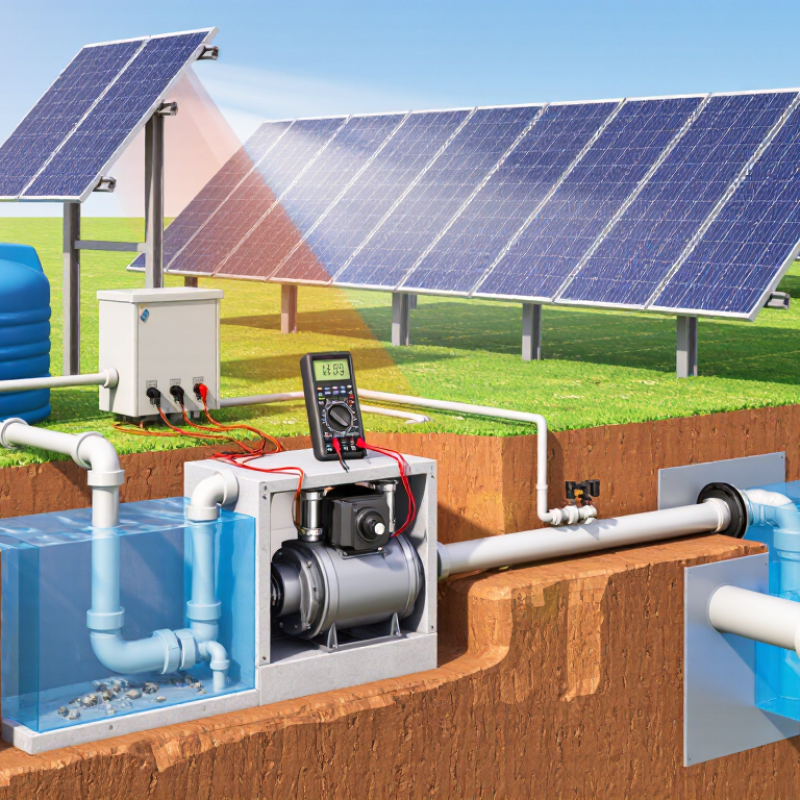
A solar pump rarely loses speed for one reason. It follows sunlight, voltage, and hydraulic load. Seven causes appear often: weak irradiance, shading, dirty modules, cable voltage drop, low array voltage, controller limits, and rising discharge pressure.
IEC 61215 testing uses 1,000 W/m² irradiance and 25°C cell temperature. Real fields often fall below that reference. A cloudy noon can produce less motor torque. Morning shadows from a tank or pole matter. So does dust.
NREL’s PVWatts documentation models irradiance, temperature, system losses, and inverter behavior, not sunshine duration alone.
Measure at the pump terminals, not only at the array. A long, thin cable can hide several volts under load. If voltage falls below the controller’s operating window, speed may hunt or collapse.
An oversized pipe, clogged filter, closed valve, or deep well increases head. The motor then spends available power pushing water instead of gaining speed.
High module temperature also reduces voltage. IEC testing commonly references 25°C, while working modules can run much hotter.
Check current, terminal voltage, irradiance, flow, and pressure together. A clamp-meter snapshot helps, but it is imperfect. Repeat testing at 9 a.m., solar noon, and mid-afternoon.
Inspect connectors for heat marks and polarity errors. Sometimes the pump is healthy; the system was designed for a brighter, lighter load than the site provides.
Shading is often the quietest cause of a slow solar pump. A nearby tree, roof edge, or water tank may cover only one panel corner. Yet bypass diodes can activate, reducing the useful string voltage. Morning shadows and seasonal sun angles are easy to miss. The International Energy Agency Photovoltaic Power Systems Programme reports that shading can create disproportionate energy losses, especially in series-connected arrays.
Partial shading also causes uneven current, which may prevent the pump controller from finding the best operating point. A small shadow can matter greatly.
Panel problems create other speed limits. Dust, bird deposits, cracked glass, loose connectors, and water intrusion reduce delivered power. The IEA PVPS Task 13 reports typical soiling losses of about 2% to 7% annually, depending on climate and cleaning frequency. That range is not universal. Dry farmland can perform worse.
Fraunhofer ISE’s Photovoltaics Report notes typical module degradation near 0.15% to 0.5% per year, although poor installation can accelerate it. Check each panel’s voltage and current under similar sunlight. Compare readings with the manufacturer’s electrical label, not a guess.
Also inspect hot spots using infrared imaging when possible. One overlooked connector may explain everything. Or not. Measure before replacing parts. A cloudy test can mislead even experienced technicians.
A solar pump may spin slowly even when the panels appear healthy. Wiring is often the hidden restriction. Undersized conductors create voltage drop, especially across long, hot cable runs. Loose terminals, damaged connectors, reversed polarity, and poor grounding can add resistance. Measure voltage directly at the controller while the pump starts, not only at the array. A five percent drop can push the controller below its operating threshold.
Controllers create the next bottleneck. An incorrect MPPT voltage range may prevent the array from operating near its maximum-power point. Current limiting can also reduce pump speed during bright sunlight. NREL’s PVWatts documentation uses a 14% default loss assumption for standard photovoltaic systems, including wiring and equipment losses. Pumping systems may perform worse when cable runs, dust, heat, and conversion stages combine. Small losses accumulate quickly.
The inverter can limit performance too. Low DC voltage, an undersized power rating, weak batteries, or an incorrect output frequency may trigger protective derating. Some inverters cannot supply the motor’s starting surge, even when their continuous rating looks adequate. IEA PVPS Task 13 reports typical module degradation near 0.5% annually, so older arrays may no longer match the original controller settings. Check frequency, phase balance, fault logs, and current limits together. Do not blame the pump too early. One overlooked setting can imitate mechanical failure.
A solar pump may run slowly for seven practical reasons: weak sunlight, dirty panels, shading, voltage loss, blocked flow, air in the intake, or worn mechanical parts. The fault is not always inside the pump. A dusty module can reduce output noticeably, especially after dry weeks. Even a small tree shadow may disturb the array’s working point.
The FAO reports that agriculture uses about 70% of global freshwater withdrawals, making dependable pumping important. Yet water demand often hides hydraulic problems. A clogged screen, narrow pipe, closed valve, or blocked outlet increases resistance. The motor then struggles to reach its rated speed. Air leaks around loose intake fittings can cause noisy, uneven operation. Check these parts while the pump is running, not only when it stops.
Wear creates slower operation too. A damaged impeller, hardened seal, loose coupling, or rough bearing wastes torque. The World Bank’s solar water-pumping guidance stresses correct system sizing, pipe design, and routine maintenance. Measure panel voltage, controller output, current, and flow rate together. One reading can mislead you. A useful but imperfect test is comparing midday flow with the original commissioning record. If speed remains low under clear sunlight, inspect the impeller and bearings. Sometimes the real mistake is assuming sunlight is the problem.
The chart shows typical motor-speed reduction ranges associated with common solar pump problems. Blocked inlets, clogged filters, worn impellers, undersized wiring, low solar irradiance, controller faults, and bearing or shaft damage can all prevent the pump from reaching its rated speed. Start with the simplest checks—sunlight, filters, wiring, and blockages—before inspecting internal mechanical parts.
A solar pump can run slowly even when the panel looks bright.
Water conditions often explain the missing speed. The World Bank’s 2018 Solar Water Pumping for Irrigation report identifies total dynamic head, flow, and pump efficiency as core sizing variables.
Seven causes
appear repeatedly: a low borewell level, air entering the suction line, muddy water, a blocked intake, excessive pipe friction, an undersized pipe, or unstable controller voltage. Each issue can reduce flow or operating voltage.
Measure the water level while pumping. Static readings can mislead.
System design creates less visible losses.
Long, narrow pipes increase friction. Elbows and check valves add further resistance. FAO guidance on solar-powered irrigation stresses matching pump curves with available solar energy and required head.
Peak horsepower alone is not enough. NREL’s PVWatts model uses a default 14% system-loss assumption, before unusual shading or wiring problems. IEA PVPS Task 13 reports typical photovoltaic degradation near 0.5% annually, although site conditions vary.
Check loaded voltage, current, dynamic head, and discharge together. A clean filter does not prove the intake is clear. A correct voltage reading does not prove sufficient current.
Record values every few minutes, then compare them with the pump curve and allowable operating range.
Strong sunlight does not always mean strong pump speed. Hot modules produce less voltage. Measure irradiance, voltage, current, flow, and pressure together. Clear skies can still hide a voltage problem.
Yes. A tank, pole, or nearby tree can shade part of the array. Even a narrow shadow may disturb its working point. Check the array at 9 a.m., noon, and mid-afternoon.
Dust reduces available electrical output. Dry weeks often leave a visible film on the module surface. Cleaning may help, but water quality and cleaning methods also matter.
Long, thin cables can lose several volts under load. Array voltage may look normal while terminal voltage falls. If voltage leaves the controller’s operating range, speed may hunt or collapse.
Yes. A clogged filter, narrow pipe, closed valve, or blocked outlet increases hydraulic resistance. The motor then spends more power moving water. The pump may be healthy.
Higher pressure increases the pump’s head load. Speed can drop, and flow may become weak. An oversized pipe system can create unexpected resistance, too.
Loose intake fittings may allow air leaks. The pump can become noisy, irregular, or slow. Inspect joints while the pump runs, not only after shutdown.
A damaged impeller, hardened seal, loose coupling, or rough bearing can waste torque. Inspect these parts when clear sunlight produces low flow. This diagnosis is useful, but not perfect.
Compare readings during morning, solar noon, and afternoon. Record terminal voltage, current, flow, pressure, and sunlight conditions. Check connectors for heat marks and reversed polarity. One snapshot can mislead.
A solar pump may fail to reach full speed when sunlight, voltage, or system load is not within the required range. Clouds, shading, dirty or damaged panels, poor orientation, and seasonal changes can reduce available solar power. Wiring that is too thin or too long, loose connections, an incorrectly configured controller, or an inverter with insufficient capacity can also limit the voltage and current delivered to the pump. If you are asking, “Why is my solar pump not reaching full speed?”, these electrical and solar-input issues are among the first areas to inspect.
Mechanical and water-related conditions can also slow operation. A blocked intake, clogged filter, restricted pipe, closed valve, worn impeller, damaged bearings, or excessive friction may prevent the motor from operating efficiently. In addition, lifting water too high, using undersized pipes, or demanding more flow than the system was designed to provide can increase the load beyond the pump’s capacity. Checking solar output, connections, controls, water flow, and mechanical components systematically can help identify the cause and restore suitable performance.
NovaVolt Service