When considering motor control solutions, one might wonder, "What is the difference between a VFD and a soft starter?" Industry expert James Adler, a senior engineer at Motion Control Solutions, states, "Understanding the nuances of these devices is crucial for optimizing energy efficiency."
Variable Frequency Drives (VFDs) and soft starters serve powerful but distinct roles in motor management. VFDs adjust motor speed and torque by varying the frequency of power supplied to the motor. This functionality enhances performance and energy savings, but it also adds complexity to the system. In contrast, soft starters limit inrush current and smoothly ramp up to full speed, preventing mechanical stress during startup.
Choosing between a VFD and a soft starter often leads to critical decisions. Each option has unique benefits and limitations. Soft starters are often easier to implement and cost-effective. Yet, VFDs offer greater control and efficiency over time. Striking the right balance for your application requires careful consideration of your operational needs and energy requirements, illustrating that the simplest choice is not always the best.
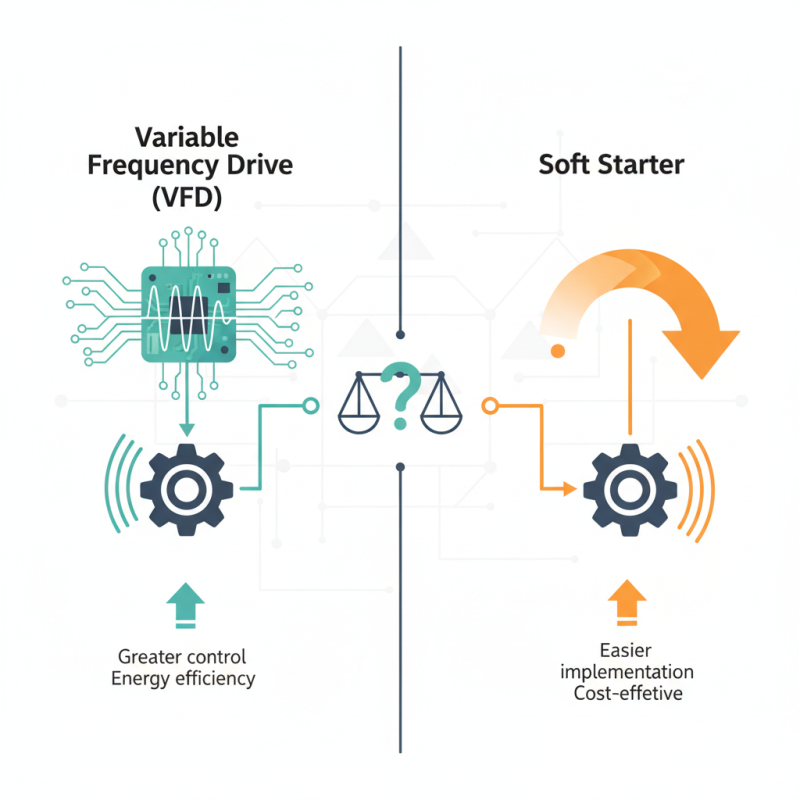
Overview of VFDs and Soft Starters
Variable Frequency Drives (VFDs) and soft starters serve different purposes in motor control. VFDs adjust the motor speed by varying the frequency and voltage supplied to the motor. This flexibility allows for precise control over process speeds and can lead to significant energy savings. They are particularly useful in applications where variable speeds are required. Industries heavily rely on VFDs for pumps, fans, and conveyor systems.
On the other hand, soft starters limit the inrush current during motor start-up. They gradually ramp up the motor's voltage, reducing mechanical stress and prolonging equipment life. Soft starters are beneficial in applications where the motor operates at a constant speed but requires gentle starts. This is common in fans, compressors, and some conveyor systems.
Despite their advantages, both technologies have limitations. VFDs can be more complex to install and program, potentially leading to initial challenges. Their cost can be a concern for smaller operations. Soft starters, while simpler, do not offer speed control. This can restrict their application in systems requiring variable speeds. Understanding these distinctions is crucial for selecting the right solution for specific needs.
Operating Principles of Variable Frequency Drives
Variable Frequency Drives (VFDs) are essential in controlling motor speed and torque. They do this by varying the frequency and voltage of the power supplied to the motor. This control enhances energy efficiency. Imagine a conveyor belt adjusting its speed based on the load. VFDs enable such flexibility in operations, making them ideal for many industrial applications.
The underlying principle of a VFD involves three main stages: rectification, filtering, and inversion. The process starts with converting AC to DC. This is followed by smoothing the DC signal to remove ripples. Finally, the DC is transformed back into adjustable AC using an inverter. Each stage has its complexities and intricacies, often requiring careful tuning. Users must understand these nuances to fully harness the potential of VFD technology.
Despite their benefits, challenges exist. Not all motors work optimally with VFDs due to harmonics and overheating risks. Users may need to invest in further equipment like filters. This reflects the balance between ease of use and the potential for complications. In practice, the integration of VFDs necessitates a proficient understanding of both electrical engineering and specific application needs.
VFD vs Soft Starter: Key Differences in Operating Principles
How Soft Starters Function in Motor Control
Soft starters play a crucial role in motor control by providing a smooth and gradual increase in motor speed. This feature prevents mechanical stress and reduces inrush current. Typically, a soft starter enables motors to start at a reduced voltage. By doing so, it limits the torque applied during startup, effectively minimizing the shock to the entire system. According to industry reports, the global soft starter market is expected to grow at a compound annual growth rate of 6.34% from 2021 to 2028.
During operation, soft starters monitor motor parameters and adjust voltage as needed. This versatility offers operators refined control over motor operations. However, one must be aware that soft starters may not protect against all faults. Some motors may still experience issues like overheating. Additionally, while soft starters reduce mechanical stress, they do not provide variable speed functionality. This limitation can affect applications that require more precise speed management.
Understanding the functional dynamics of soft starters is crucial. Research indicates that nearly 60% of motor-related failures stem from improper starting methods. Therefore, utilizing soft starters can significantly mitigate risks. However, it's essential to assess individual application needs carefully. Every situation is unique, and soft starters may not be the perfect fit for all scenarios. This disparity begs a closer examination of your specific requirements.
Key Differences in Application Scenarios
When evaluating the application scenarios for VFDs (Variable Frequency Drives) and soft starters, distinct differences emerge. VFDs are designed for controlling motor speed and torque, making them ideal for applications needing variable speed. They excel in environments where fine-tuning of motor performance is crucial. This includes HVAC systems, conveyors, and pumps. By adjusting frequency, VFDs enhance energy efficiency, helping businesses save on energy costs.
On the other hand, soft starters are used primarily for reducing inrush current during motor startups. They're simpler and more economical for applications requiring smooth starting without complex speed control. Industries utilizing soft starters often include manufacturing and mining, where machines need a gentle ramp-up to avoid stresses on equipment. However, they lack the versatility of VFDs for ongoing motor speed adjustments. Choosing between these options often requires reflecting on specific use cases, and this can sometimes lead to oversights. It's rare to find a one-size-fits-all solution, so careful consideration is essential.
Cost Considerations and System Efficiency Comparison
When comparing VFDs (Variable Frequency Drives) and soft starters, cost considerations and system efficiency are critical elements. VFDs offer more extensive control over motor speed and torque. This flexibility can lead to significant energy savings. However, their higher initial cost can be a barrier for some businesses. Soft starters, while less expensive upfront, focus mainly on reducing inrush current during motor start. They do not provide the same operational efficiency.
Operational efficiency is vital for long-term savings. A VFD can adapt motor speed to match load demands, enhancing energy use. This capability translates to lower energy bills and reduced wear on equipment. Soft starters, on the other hand, might fall short in efficiency during regular operation. Their primary benefit lies in smooth starts, and once the motor is running, they do little to optimize performance.
Considering maintenance and lifespan is also important. VFDs may require more specialized knowledge for repairs, leading to potential downtime. Soft starters tend to be simpler but may not achieve optimal efficiency over time. Each option has its strengths and weaknesses, reflecting varying industry needs.
VFD vs Soft Starter: Key Differences, Cost Considerations, and System Efficiency Comparison
| Criteria |
VFD (Variable Frequency Drive) |
Soft Starter |
| Functionality |
Controls motor speed and torque |
Limits inrush current during motor start |
| Cost |
Higher initial cost, potential for energy savings |
Lower initial cost, no significant energy savings |
| Energy Efficiency |
Highly efficient, adjusts speed to load demands |
Less efficient, runs at full speed once started |
| Applications |
Used in variable speed applications (e.g., pumps, fans) |
Typically used in simple start/stop applications |
| Maintenance |
Requires periodic maintenance and programming |
Generally lower maintenance requirements |
| Control Complexity |
More complex, with programmable features |
Simpler control logic |
FAQS
: Soft starters provide a smooth increase in motor speed to prevent mechanical stress.
They allow motors to start at a reduced voltage, limiting startup torque.
No, they do not protect against all faults; some motors may still overheat.
No, they focus on smooth starts and do not offer variable speed control.
Research indicates that nearly 60% of failures stem from improper starting techniques.
Soft starters are typically less expensive upfront than VFDs but offer less control.
They do little to optimize performance after the motor is running.
No, each situation is unique, and soft starters may not fit every application.
VFDs offer extensive control over motor speed and torque, enhancing energy efficiency.
They require more complex repairs, leading to potential downtime for businesses.
Conclusion
In the realm of motor control, many often wonder, "What is the difference between a VFD and a soft starter?" Both devices serve to optimize motor performance, yet they operate through distinct principles. Variable Frequency Drives (VFDs) control the speed and torque of an electric motor by varying the frequency and voltage of the power supplied, allowing for precise control in various applications. In contrast, soft starters function by gradually ramping up the voltage to the motor during startup, reducing inrush current and minimizing mechanical stress without altering the motor speed during normal operation.
When considering application scenarios, VFDs are typically used in processes requiring speed variability, such as pumps and fans, whereas soft starters are ideal for reducing starting torque in applications like conveyors or crushers. Additionally, cost considerations reveal that although VFDs may have higher upfront investments, their ability to improve system efficiency can lead to long-term savings. In summary, understanding the differences between these two motor control options is crucial for selecting the right technology to suit specific operational needs.

 NovaVolt Service